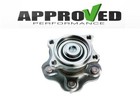




Rear ( Back ) Wheel Hub Bearing Assembly | |||
Description | |||
ALL NEW Rear Wheel Hub Bearing Assembly *WE SHIP VIA FED EX MONDAY-FRIDAY (HOLIDAYS EXCLUDED) 99% OF THE ORDERS ARE SHIPPED WITHIN 1 BUSINESS DAY OF THE PAYMENT BEING RECEIVED. AGAIN WEEKENDS AND HOLIDAYS ARE EXCLUDED. ANY AND ALL ORDERS PLACED AND PAID FOR AFTER 1:00 PM FRIDAY WILL SHIP ON THE FOLLOWING BUSINESS DAY. ***1 Year Warranty *** You have purchased a premium quality product designed to
replace your original equipment brakes. There is absolutely No modifications
required to the product or your vehicle to install. The warranty covers cracking warping and manufactures defects,
The Warranty is from the original date of purchase. It is a 1 time replacement
and covers the product / products purchased only, it does not cover the cost of
labor to remove or install any of the products. Warranty does not cover units that have been modified, abused,
or are used for anything other than its intended use which is the same as its original
equipment intentions. Warranty is VOID if used on vehicles for racing or off
road use. Customer is responsible for freight charges to return the
alleged defective product. FEATURES & BENEFITS:
FAQ Q: How quick can I get my order? | |||
| |||
Hub Bearing Installation Instructions Park
the vehicle
on a flat, level paved or concrete surface. Place the vehicle in gear or park
and apply the parking brake, chock opposite wheel to prevent the vehicle from
rolling. Loosen the lug nuts
on the wheel of the hub bearing you're replacing with the breaking bar and a
socket; do not remove them Only Loosen Lift the wheel with
the floor jack in a safe and secure manner. Support the vehicle on a jack
stand, preferably on the frame rail if present. Remove the lug nuts
and wheel. Locate and remove the
caliper bolts with ratchet and a socket. Remove caliper gently
and support the caliper. Do not allow the caliper to dangle on the rubber brake
hose. Locate
the caliper bracket bolts (if applicable) and remove them with the ratchet and
a socket. You may want to break them loose with the breaking bar first if
they're really tight. On some vehicles the brake pads will remain in the
bridge and can be removed by prying out with the screwdriver. On other models,
the pads stay intact and may be clipped to the caliper. If you have to remove
the pads, do so by taking note how they were placed in the bridge and be sure
you're able to put them back in the same manner they were extracted.
Remove the rotor. If
it is stuck to the hub, you may have to hit it between the studs with a large
rubber mallet. Use a rubber mallet if you're not going to replace the rotor, so
you don't damage the surface. Remove any ABS wires
attached to the hub bearing assembly (if applicable) or unclip the wire and
trace it to the plug. In many applications, if the ABS wire is integrated with
the wheel-bearing hub assembly, a new one will come with it. If you're not
sure, check the box of the new bearing and if there's an ABS wire, follow the
wire until you locate the plug, unplug it and unclip it from its mounts. If ABS
is present but not integrated with the bearing assembly, remove the sensor from
the bearing with a ratchet and socket. Remove the spindle
nut with the breaking bar and a spindle nut socket. Remove the washer behind
the spindle nut. Locate the
wheel-bearing assembly bolts behind the knuckle, (If Applicable see replacement
unit for type of mounting) and loosen them with the breaking bar and socket.
The location of these can sometimes create a tight area to place a socket and
tool on to remove them with. You may have to apply some ingenuity. Replace the
socket on the ratchet to extract the bolts quickly and easier. Most hubs have
three or four bolts. Install the slide
hammer onto the lug studs and secure with tightened lug nuts. This may take
several attempts and a couple of breaks in between to remove the hub bearing
from the knuckle. Pay close attention to your progress and try to determine
when the bearing will separate. Take note of how the backing plate is installed
between the knuckle and the bearing so you can replace it in the same manner.
Note some models will slide off the spindle without the need of a slide hammer. Sand off the rust and
corrosion around the knuckle with a fine- to medium-grade sandpaper. Move the
drive-shaft spindle around to get it out of your way. Take your time when doing
this and make sure it's as clean as possible. Place the backing
plate in its original position and place the new bearing onto the knuckle.
Manipulate the drive-shaft spindle splines into the center of the hub bearing.
Push the bearing on as far as you can, making sure to line it up correctly if
ABS lines or plugs are present. Replace the
wheel-bearing assembly bolts. They're pretty long, so as soon as you can thread
them into the new bearing, start to tighten them. Pull the bearing in by
tightening the bolts a little bit at a time and then switching to the next bolt
to make sure the bearing assembly does not shift in the knuckle and cause
damage. Once the bearing is drawn in flush, use the breaking bar to get the
bolts as tight as you can get them. Replace washer and
spindle nut and tighten to proper torque
specifications with the half-inch drive torque wrench and spindle socket.
Do Not Over Tighten you could damage the new Hub Assembly. Replace the brakes in
the same manner you extracted them. You may need to push the caliper piston in
a bit with a C-clamp to get it over the rotor. (Note some rear calipers have a
piston that screws in. DO NOT use a C Clamp on this type of caliper piston) Plug
in the ABS lines or reattach them to the bearing, if applicable. Replace the tire and
lug nuts, and tighten the lug nuts as tight as you can get them. Lower the vehicle and
tighten the lug nuts in an alternate fashion with the torque wrench and socket
at the correct wheel nut specifications torque setting. Pump the brake pedal
if you had to push the caliper piston in with a C-clamp to restore hydraulic
pressure to that caliper piston.
Release
the parking brake, remove chock and go for a test drive. | |||