



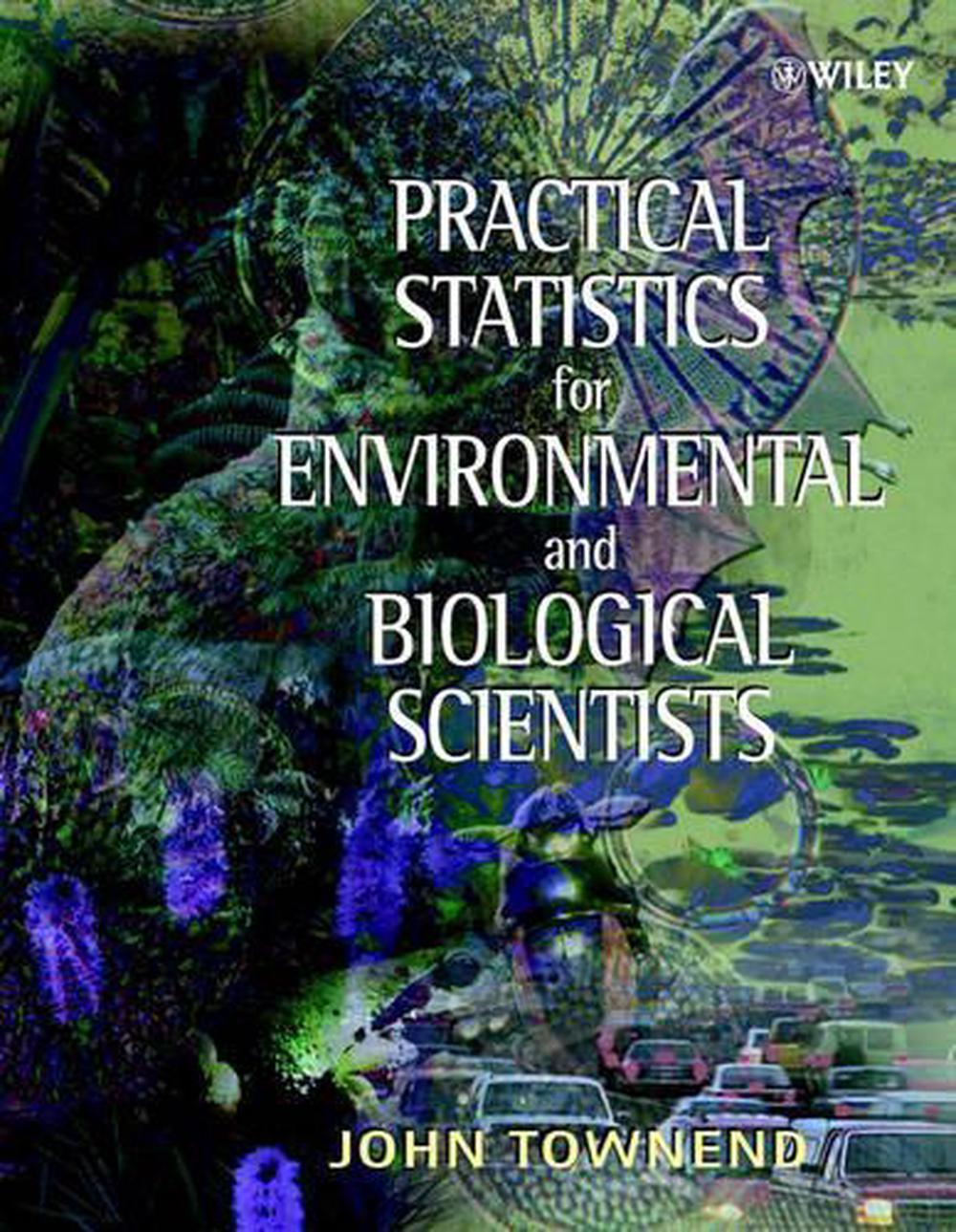
Practical Statistics for Environmental and Biological Scientists
by John Townend
All students and researchers in environmental and biological sciences require statistical methods at some stage of their work. Many have a preconception that statistics are difficult and unpleasant and find that the textbooks available are difficult to understand.
Paperback
English
Brand New
Publisher Description
All students and researchers in environmental and biological sciences require statistical methods at some stage of their work. Many have a preconception that statistics are difficult and unpleasant and find that the textbooks available are difficult to understand.
Practical Statistics for Environmental and Biological Scientists provides a concise, user-friendly, non-technical introduction to statistics. The book covers planning and designing an experiment, how to analyse and present data, and the limitations and assumptions of each statistical method. The text does not refer to a specific computer package but descriptions of how to carry out the tests and interpret the results are based on the approaches used by most of the commonly used packages, e.g. Excel, MINITAB and SPSS. Formulae are kept to a minimum and relevant examples are included throughout the text.
Back Cover
Practical Statistics for Environmental and Biological Scientists is a concise, user-friendly, non-technical introduction to statistics. Starting from basics, this book carefully introduces those statistical methods and techniques that all students and researchers need to know. Written in an accessible style, the book divides into two parts. The first part covers statistical principles, how to plan and design experiments and surveys, and the presentation of data. The second part introduces a range of statistical tests and methods commonly used in environmental and biological sciences. The limitations and assumptions of each statistical method are clearly described along with numerous relevant examples for the applications of the techniques. Practical Statistics for Environmental and Biological Scientists: Is an accessible introduction to key statistical techniques used in the environmental and biological sciences. Includes relevant examples throughout the text with references for further reading. Illustrates concepts and methods and the presentation of data through numerous tables and figures. Provides an appendix describing how many of the tests can be carried out using Excel and Minitab Written for undergraduate students studying within the environmental and biological sciences. Researchers and professionals will also find this an invaluable reference.
Flap
Practical Statistics for Environmental and Biological Scientists is a concise, user-friendly, non-technical introduction to statistics. Starting from basics, this book carefully introduces those statistical methods and techniques that all students and researchers need to know. Written in an accessible style, the book divides into two parts. The first part covers statistical principles, how to plan and design experiments and surveys, and the presentation of data. The second part introduces a range of statistical tests and methods commonly used in environmental and biological sciences. The limitations and assumptions of each statistical method are clearly described along with numerous relevant examples for the applications of the techniques. Practical Statistics for Environmental and Biological Scientists: * Is an accessible introduction to key statistical techniques used in the environmental and biological sciences. * Includes relevant examples throughout the text with references for further reading. * Illustrates concepts and methods and the presentation of data through numerous tables and figures. * Provides an appendix describing how many of the tests can be carried out using Excel and Minitab Written for undergraduate students studying within the environmental and biological sciences. Researchers and professionals will also find this an invaluable reference.
Table of Contents
Preface ix Part I Statistics Basics 1 1 Introduction 3 1.1 Do you need statistics? 3 1.2 What is statistics? 4 1.3 Some important lessons I have learnt 5 1.4 Statistics is getting easier 6 1.5 Integrity in statistics 7 1.6 About this book 8 2 A Brief Tutorial on Statistics 9 2.1 Introduction 9 2.2 Variability 9 2.3 Samples and populations 10 2.4 Summary statistics 11 2.5 The basis of statistical tests 19 2.6 Limitations of statistical tests 24 3 Before You Start 27 3.1 Introduction 27 3.2 What statistical methods are available? 28 3.3 Surveys and experiments 33 3.4 Designing experiments and surveys — preliminaries 35 3.5 Summary 43 4 Designing an Experiment or Survey 45 4.1 Introduction 45 4.2 Sample size 45 4.3 Sampling 50 4.4 Experimental design 56 4.5 Further reading 60 5 Exploratory Data Analysis and Data Presentation 63 5.1 Introduction 63 5.2 Column graphs 65 5.3 Line graphs 67 5.4 Scatter graphs 69 5.5 General points about graphs 71 5.6 Tables 73 5.7 Standard errors and error bars 74 6 Common Assumptions or Requirements of Data for Statistical Tests 77 6.1 Introduction 77 6.2 Common assumptions 81 6.3 Transforming data 84 Part II Statistical Methods 91 7 t-tests and F-tests 93 7.1 Introduction 93 7.2 Limitations and assumptions 94 7.3 t-tests 95 7.4 F-test 103 7.5 Further reading 105 8 Analysis of Variance 107 8.1 Introduction 107 8.2 Limitations and assumptions 109 8.3 One-way ANOVA 111 8.4 Multiway ANOVA 119 8.5 Further reading 127 9 Correlation and Regression 129 9.1 Introduction 129 9.2 Limitations and assumptions 130 9.3 Pearson's product moment correlation 131 9.4 Simple linear regression 135 9.5 Correlation or regression? 142 9.6 Multiple linear regression 143 9.7 Comparing two lines 146 9.8 Fitting curves 148 9.9 Further reading 151 10 Multivariate ANOVA 153 10.1 Introduction 153 10.2 Limitations and assumptions 154 10.3 Null hypothesis 156 10.4 Description of the test 156 10.5 Interpreting the results 158 10.6 Further reading 161 11 Repeated Measures 163 11.1 Introduction 163 11.2 Methods for analysing repeated measures data 166 11.3 Designing repeated measures experiments 170 11.4 Further reading 170 12 Chi-square Tests 173 12.1 Introduction 173 12.2 Limitations and assumptions 174 12.3 Goodness of fit test 175 12.4 Test for association between two factors 178 12.5 Comparing proportions 181 12.6 Further reading 184 13 Non-parametric Tests 185 13.1 Introduction 185 13.2 Limitations and assumptions 188 13.3 Mann—Whitney U-test 189 13.4 Two-sample Kolmogorov—Smirnov test 191 13.5 Two-sample sign test 193 13.6 Kruskal—Wallis test 195 13.7 Friedman's test 198 13.8 Spearman's rank correlation 200 13.9 Further reading 203 14 Principal Component Analysis 205 14.1 Introduction 205 14.2 Limitations and assumptions 207 14.3 Description of the method 207 14.4 Interpreting the results 209 14.5 Further reading 218 15 Cluster Analysis 221 15.1 Introduction 221 15.2 Limitations and assumptions 222 15.3 Clustering observations 223 15.4 Clustering variables 226 15.5 Further reading 228 Appendices 229 A Calculations for statistical tests 231 B Concentration data for Chapters 14 and 15 247 C Using computer packages 249 D Choosing a test: decision table 261 E List of worked examples 265 Bibliography 271 Index 273
Review
"The reassuring tone and straightforward approach of the book would be a useful guide..." (Biochemistry and Molecular Education, July/August 2002) "...covers the basics of designing an experiment/survey, data analysis and presentation, and specific methods." (SciTech Book News, Vol. 26, No. 2, June 2002) "...a good and clear exposition of basic statistical techniques..." (Biometrics, December 2002) "…This no-nonsense approach to elementary statistics should get you or your student started…" (European Journal of Soil Science, March 2003) "...This book provides a concise, userfriendly, non-technical introduction to statistics". (Metrohm Information, Vol.32, No.1, 2003)
Long Description
Practical Statistics for Environmental and Biological Scientists is a concise, user-friendly, non-technical introduction to statistics. Starting from basics, this book carefully introduces those statistical methods and techniques that all students and researchers need to know. Written in an accessible style, the book divides into two parts. The first part covers statistical principles, how to plan and design experiments and surveys, and the presentation of data. The second part introduces a range of statistical tests and methods commonly used in environmental and biological sciences. The limitations and assumptions of each statistical method are clearly described along with numerous relevant examples for the applications of the techniques. Practical Statistics for Environmental and Biological Scientists : Is an accessible introduction to key statistical techniques used in the environmental and biological sciences. Includes relevant examples throughout the text with references for further reading. Illustrates concepts and methods and the presentation of data through numerous tables and figures. Provides an appendix describing how many of the tests can be carried out using Excel and Minitab Written for undergraduate students studying within the environmental and biological sciences. Researchers and professionals will also find this an invaluable reference.
Review Text
"The reassuring tone and straightforward approach of the book would be a useful guide...? (Biochemistry and Molecular Education, July/August 2002) "...covers the basics of designing an experiment/survey, data analysis and presentation, and specific methods." (SciTech Book News, Vol. 26, No. 2, June 2002) "...a good and clear exposition of basic statistical techniques..." (Biometrics, December 2002) "?This no-nonsense approach to elementary statistics should get you or your student started?" (European Journal of Soil Science, March 2003) Â "...This book provides a concise, Â userfriendly, non-technical introduction to statistics". (Metrohm Information, Vol.32, No.1, 2003)
Review Quote
"The reassuring tone and straightforward approach of the book would be a useful guide..." ( Biochemistry and Molecular Education , July/August 2002) "...covers the basics of designing an experiment/survey, data analysis and presentation, and specific methods." ( SciTech Book News , Vol. 26, No. 2, June 2002) "...a good and clear exposition of basic statistical techniques..." (Biometrics, December 2002) "...This no-nonsense approach to elementary statistics should get you or your student started..." (European Journal of Soil Science, March 2003)
Promotional "Headline"
"The reassuring tone and straightforward approach of the book would be a useful guide..." (Biochemistry and Molecular Education, July/August 2002)"...covers the basics of designing an experiment/survey, data analysis and presentation, and specific methods." (SciTech Book News, Vol. 26, No. 2, June 2002)"...a good and clear exposition of basic statistical techniques..." (Biometrics, December 2002)"...This no-nonsense approach to elementary statistics should get you or your student started..." (European Journal of Soil Science, March 2003) "...This book provides a concise, userfriendly, non-technical introduction to statistics". (Metrohm Information, Vol.32, No.1, 2003)
Feature
Each chapter includes a further reading section. User-friendly and avoids technical jargon. Relevant biological and environmental examples are offered throughout.
Details