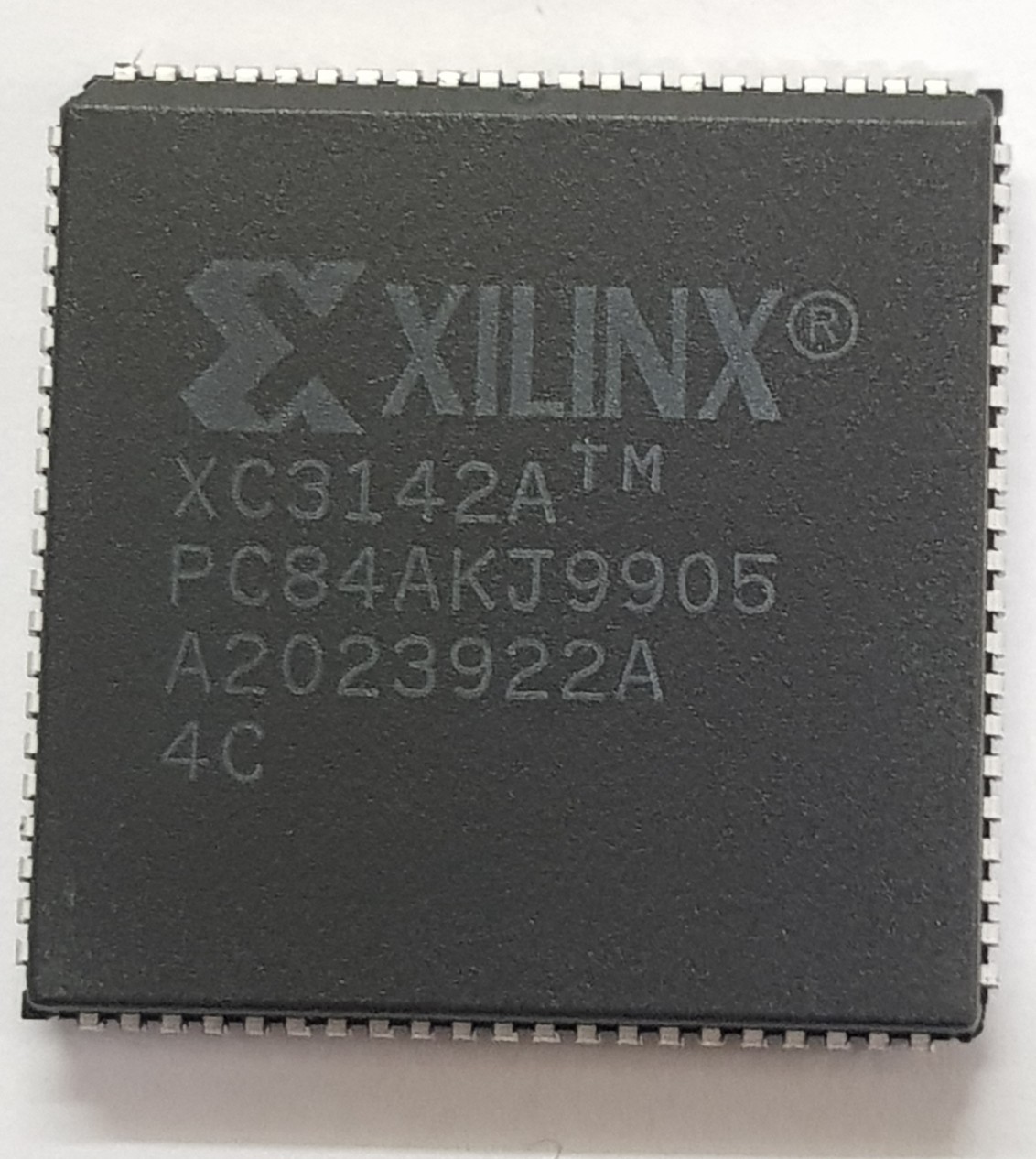
XC3000-Series Field Programmable Gate Arrays (FPGAs) provide a group of high-performance, high-density, digital integrated circuits. Their regular, extendable, flexible, user-programmable array architecture is composed of a configuration program store plus three types of configurable elements: a perimeter of I/O Blocks (IOBs), a core array of Configurable Logic Bocks (CLBs) and resources
for interconnection. The general structure of an FPGA is shown in Figure 2. The development system provides schematic capture and auto place-and-route for design entry. Logic and timing simulation, and in-circuit emulation
are available as design verification alternatives. The design editor is used for interactive design optimization, and to compile the data pattern that represents the configuration program.
The FPGA user logic functions and interconnections are determined by the configuration program data stored in internal static memory cells. The program can be loaded in any of several modes to accommodate various system
requirements. The program data resides externally in an EEPROM, EPROM or ROM on the application circuit board, or on a floppy disk or hard disk. On-chip initialization logic provides for optional automatic loading of program
data at power-up. The companion XC17XX Serial Configuration PROMs provide a very simple serial configuration program storage in a one-time programmable package.
The XC3000 Field Programmable Gate Array families provide a variety of logic capacities, package styles, temperature ranges and speed grades.
COLLECTION WELCOME
Similar Listings
ICE40LP1K-QN84 iCE40™ LP Field Programmable Gate Array (FPGA) IC 84 QFN