




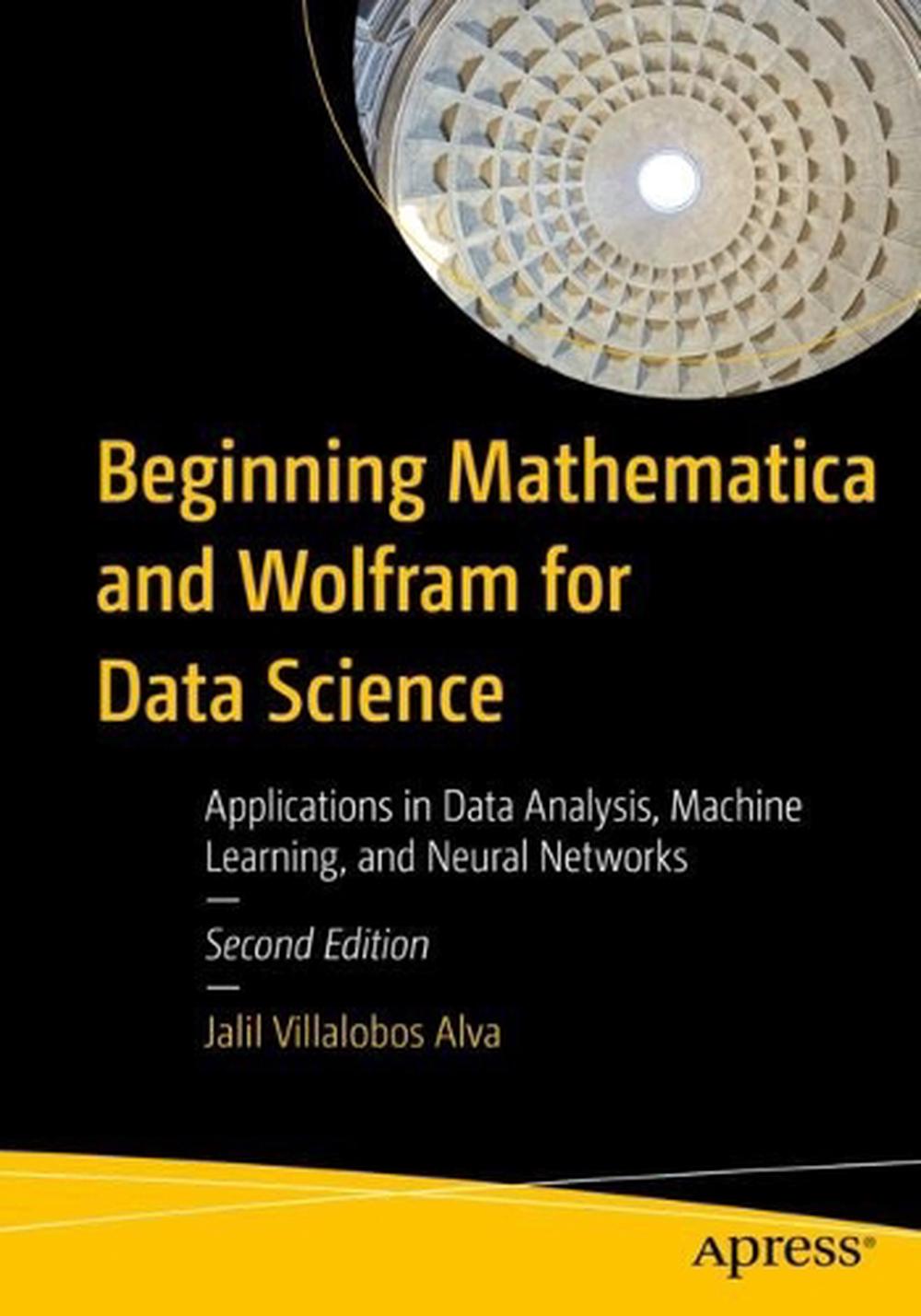
Beginning Mathematica and Wolfram for Data Science
by Jalil Villalobos Alva
Enhance your data science programming and analysis with the Wolfram programming language and Mathematica, an applied mathematical tools suite.
Paperback
Brand New
Publisher Description
Enhance your data science programming and analysis with the Wolfram programming language and Mathematica, an applied mathematical tools suite. This second edition introduces the latest LLM Wolfram capabilities, delves into the exploration of data types in Mathematica, covers key programming concepts, and includes code performance and debugging techniques for code 'll gain a deeper understanding of data science from a theoretical and practical perspective using Mathematica and the Wolfram Language. Learning this language makes your data science code better because it is very intuitive and comes with pre-existing functions that can provide a welcoming experience for those who use other programming languages. Existing topics have been reorganized for better context and to accommodate the introduction of Notebook styles. The book also incorporates new functionalities in code versions 13 and 14 for imported and exported data. You'll see how to use Mathematica, where data management and mathematical computations are needed. Along the way, you'll appreciate how Mathematica provides an entirely integrated platform: its symbolic and numerical calculation result in a mized syntax, allowing it to carry out various processes without superfluous lines of code. You'll learn to use its notebooks as a standard format, which also serves to create detailed reports of the processes carried You Will Learn
- Create datasets, work with data frames, and create tables
- Import, export, analyze, and visualize data
- Work with the Wolfram data repository
- Build reports on the analysis
- Use Mathematica for machine learning, with different algorithms, including linear, multiple, and logistic regression; decision trees; and data clustering
Table of Contents
1. Introduction to Mathematica.- 2. Data Manipulation.- 3. Working with Data and Datasets.- 4. Import and Export.- 5. Data Visualization.- 6. Statistical Data Analysis.- 7. Data Exploration.- 8. Machine Learning with the Wolfram Language.- 9. Neural Networks with the Wolfram Language.- 10. Neural Network Framework.
Details


