



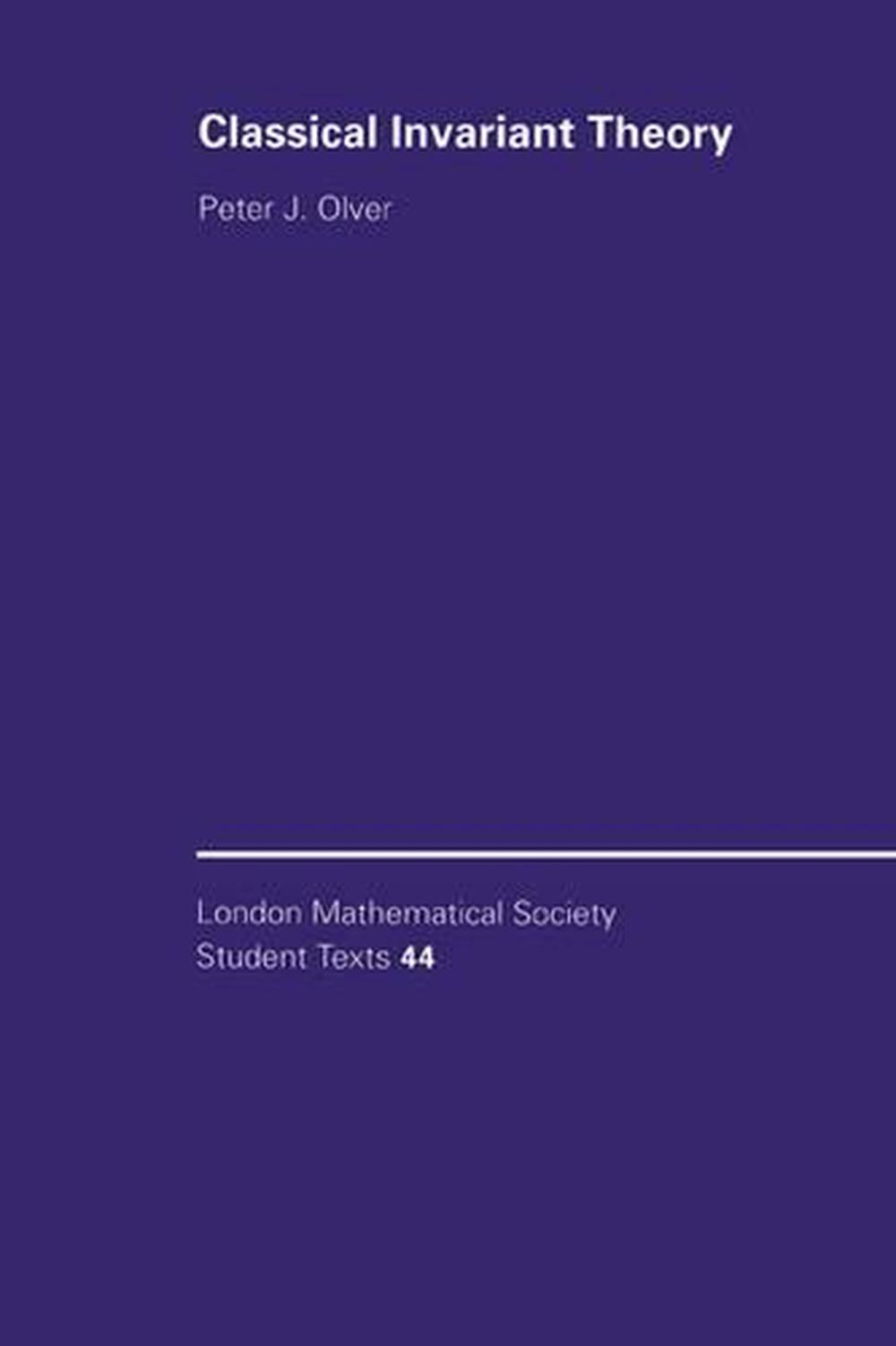
Classical Invariant Theory
by Peter J. Olver
The book is a self-contained introduction to the results and computational methods in classical invariant theory. It relies on minimal mathematical prerequisites, and can be read by advanced undergraduate or graduate students. A variety of innovations will also make the book of interest to specialists and researchers.
Paperback
English
Brand New
Publisher Description
There has been a resurgence of interest in classical invariant theory driven by several factors: new theoretical developments; a revival of computational methods coupled with powerful new computer algebra packages; and a wealth of new applications, ranging from number theory to geometry, physics to computer vision. This book provides readers with a self-contained introduction to the classical theory as well as modern developments and applications. The text concentrates on the study of binary forms (polynomials) in characteristic zero, and uses analytical as well as algebraic tools to study and classify invariants, symmetry, equivalence and canonical forms. A variety of innovations make this text of interest even to veterans of the subject; these include the use of differential operators and the transform approach to the symbolic method, extension of results to arbitrary functions, graphical methods for computing identities and Hilbert bases, complete systems of rationally and functionally independent covariants, introduction of Lie group and Lie algebra methods, as well as a new geometrical theory of moving frames and at advanced undergraduate and graduate students the book includes many exercises and historical details, complete proofs of the fundamental theorems, and a lively and provocative exposition.
Table of Contents
Introduction; Notes to the reader; A brief history; Acknowledgements; 1. Prelude - quadratic polynomials and quadratic forms; 2. Basic invariant theory for binary forms; 3. Groups and transformations; 4. Representations and invariants; 5. Transvectants; 6. Symbolic methods; 7. Graphical methods; 8. Lie groups and moving frames; 9. Infinitesimal methods; 10. Multi-variate polynomials; References; Author index; Subject index.
Review
'… impressive … a beautiful book.' Liam O'Carroll, Bulletin of the London Mathematical Society
Promotional
The book is a self-contained introduction to the results and methods in classical invariant theory.
Review Quote
'... impressive ... a beautiful book.' Liam O'Carroll, Bulletin of the London Mathematical Society
Promotional "Headline"
The book is a self-contained introduction to the results and methods in classical invariant theory.
Description for Bookstore
The book is a self-contained introduction to the results and computational methods in classical invariant theory. It relies on minimal mathematical prerequisites, and can be read by advanced undergraduate or graduate students. A variety of innovations will also make the book of interest to specialists and researchers.
Description for Library
The book is a self-contained introduction to the results and computational methods in classical invariant theory. It relies on minimal mathematical prerequisites, and can be read by advanced undergraduate or graduate students. A variety of innovations will also make the book of interest to specialists and researchers.
Details