

We stand behind every product we sell.
All of our brand new items come with a 30-Day money-back or exchange guarantee.



|
|
|

|

|

|

|

|
Compatibility: please check the compatibility before you purchase.
2005-2009 Buick LaCrosse 3.8L
2007-2008 Buick Lucerne 3.8L
2009-2011 Buick Lucerne 3.9L
2005 Buick Rainier 5.3L
2006 Buick Rendezvous 3.5L
2004-2005 Cadillac CTS 5.7L
2009-2013 Cadillac CTS 6.2L
2003-2005 Cadillac Escalade 5.3L
2003 Chevrolet Avalanche 1500 5.3L
2008-2013 Chevrolet Avalanche 5.3L
2008-2009 Chevrolet Avalanche 6.0L
2005-2010 Chevrolet Cobalt 2.2L
2006-2008 Chevrolet Cobalt 2.4L
2008-2009 Chevrolet Equinox 3.4L
2006-2010 Chevrolet HHR 2.2L
2009-2010 Chevrolet HHR 2.4L
2007-2008 Chevrolet Malibu 2.2L
2004-2010 Chevrolet Malibu 3.5L
2008-2012 Chevrolet Malibu 3.6L
2006-2007 Chevrolet Malibu 3.9L
2007-2013 Chevrolet Silverado 1500 4.8L
2003-2013 Chevrolet Silverado 1500 5.3L
2007-2013 Chevrolet Silverado 1500 6.0L
2010-2013 Chevrolet Silverado 1500 6.2L
2007-2010 Chevrolet Silverado 2500 HD 6.0L
2007-2010 Chevrolet Silverado 3500 HD 6.0L
2013-2014 Chevrolet Spark 1.2L
2003-2013 Chevrolet Suburban 1500 5.3L
2008-2009 Chevrolet Suburban 1500 6.0L
2009 Chevrolet Suburban 2500 6.0L
2005 Chevrolet Trailblazer EXT 5.3L
2007-2008 GMC Acadia 3.6L
2005 GMC Envoy 5.3L
2005 GMC Envoy XL 5.3L
2005 GMC Envoy XUV 5.3L
2007-2013 GMC Sierra 1500 4.8L
2003-2005 2008-2013 GMC Sierra 1500 5.3L
2007-2013 GMC Sierra 1500 6.0L
2008-2013 GMC Sierra 1500 6.2L
2007-2010 GMC Sierra 2500 HD 6.0L
2007-2010 GMC Sierra 3500 HD 6.0L
2008-2009 GMC Yukon 4.8L
2003-2005 2008-2012 GMC Yukon 5.3L
2008-2012 GMC Yukon 6.0L
2008-2012 GMC Yukon 6.2L
2005 Isuzu Ascender 5.3L
2007-2009 Pontiac G5 2.2L
2007-2008 Pontiac G5 2.4L
2006 Pontiac G6 2.4L
2005-2006 2008-2010 Pontiac G6 3.5L
2008-2009 Pontiac G6 3.6L
2006-2009 Pontiac G6 3.9L
2008-2009 Pontiac G8 6.0L
2009 Pontiac G8 6.2L
2005 Pontiac Montana 3.5L
2006-2007 Pontiac Solstice 2.4L
2006-2009 Pontiac Torrent 3.4L
2005 Saab 9-7x 5.3L
2007-2008 Saturn Aura 3.5L
2007-2009 Saturn Aura 3.6L
2005-2007 Saturn Ion 2.2L
2006-2007 Saturn Ion 2.4L
2007 Saturn Sky 2.4L
2006-2007 Saturn Vue 2.2L
2007 Saturn Vue 2.4L
2008-2009 Saturn Vue 3.5L
2008-2010 Saturn Vue 3.6L
Feature:
Oxygen Sensor Q & A
1. How many oxygen sensors are on today's engines?
It depends on the model year and type of engine. On most four and straight six cylinder engines, there is usually a single oxygen sensor mounted in the exhaust manifold. On V6, V8 and V10 engines, there are usually two oxygen sensors, one in each exhaust manifold. This allows the computer to monitor the air/fuel mixture from each bank of cylinders.
On later model vehicles with OBD II (some 1993 and '94 models, and all 1995 and newer models), one or two additional oxygen sensors are also mounted in or behind the catalytic converter to monitor converter efficiency. These are referred to as the downstream O2 sensors, and thee will be one for each converter if the engine has dual exhausts with separate converters.
2.Where is Oxygen Sensor Locations?
When troubleshooting oxygen sensor problems with a scan tool, you may find a diagnostic trouble code for one of the O2 sensors. The code displayed on your scan tool will indicate the type of fault, and identify one of the oxygen sensors by its position in the exhaust system.
The oxygen sensor's location will be identified by position (sensor 1, sensor 2 or sensor 3), and by cylinder bank (bank 1 or bank 2).
Most late model engines have multiple oxygen sensors, so which one is sensor 1, 2 or 3, and how do you know which cylinder bank is 1 or 2?
On straight four and six cylinder engines, there is only one bank of cylinders. So all of the oxygen sensors will be bank 1. The oxygen sensor or Air/Fuel sensor closest to the engine in the exhaust manifold will always be Sensor 1. The O2 sensor located in or behind the catalytic converter will be Sensor 2.
The location of the number one cylinder on import engines will vary depending on the year/make/model. One way to find number one cylinder so you can identify bank 1 is to look at the ignition system. If it has a distributorless ignition system (DIS) or a coil-on-plug (COP) ignition, the plug wires or coils may have lettering or marking indicating the cylinder numbers.
If a V6, V8 or V10 engine has dual exhausts with dual converters, the downstream O2 sensors would be labeled Bank 1, Sensor 2 and Bank 2, Sensor 2. Or, the downstream oxygen sensor might be labeled Bank 1 Sensor 3 if the engine has two upstream oxygen sensors in the exhaust manifold (some do to more accurately monitor emissions).
3.how to replace an oxygen sensor
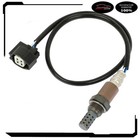
Step 1. Locate the oxygen sensor on your vehicle by looking for a part that looks like a spark plug that sticks out from the exhaust pipe. It will have an electrical connection attached to it.
Step 2. Disconnect the electrical connection on the oxygen sensor. Use a flat tip screwdriver to push in the tabs and pull the connection apart.
Step 3. Unscrew the oxygen sensor off the exhaust pipe using either an open-end wrench or a special socket made to remove it. The majority of oxygen sensors will take an SAE 7⁄8 inch (2.2 cm) wrench.
Step 4. Compare your new oxygen sensor to the old one. If the new one did not come with an electrical connection, but just with the wires stubbed out, you need to do a little work.
?Cut off the old connector from the bad oxygen sensor, strip the wires and solder the wires to the new oxygen sensor. You can also use butt connectors.
?Use heat sensitive shrink tape to seal the connections.
?Follow manufacturer's instructions to know which wires to tie together.
Step 5. Reverse the steps used in removing the oxygen sensor and install the new part. Add a small amount of anti-seize to the threads of the new sensor. Screw it in place clockwise and snug it down with the socket or open-end wrench. Do not over tighten the sensor as you might strip the threads.
Step 6. Plug the electrical connections back in.
Step 7. Turn on the ignition key, but do not start your vehicle. Use the diagnostic scanner/reader to clear the code from the vehicle's computer.
Step 8. Start the car. You should notice an immediate improvement.
Contact us:
Please contact us if you have any question.
| Item Specifics | |
|---|---|
| Brand | PMT2018 |
| Manufacturer Part Number | PT0661321AM |
| Manufacturer Warranty | 1 Year |
| Type | Oxygen Sensor |
| Custom Bundle | No |
| Fitment Type | Direct Replacement |
| Number of Pieces | 1 |
| Modified Item | No |
| Interchange Part Number | 250-24470 |
| Other Part Number | 25024470 |
| Superseded Part Number | 9592000 |
| Connector Gender | Male |
| Length (inches) | 17.32 |
| Wire Quantity | 4 |
| Sensor Type | Heated |
| Automotive Color / Finish | Steel |
| Thread Size | M18 |
| Universal Or Specific Fit | Specific |
| Output Signal Range (V) | 0.2 To 0.8 Volt |
| Attachment Method | Screw-On |
| Pin Quantity | 4 |
| Terminal Type | Blade |
| Position | Upstream, Downstream |
| Feature | ESCP |
| Type | Sensor |
| Features | Direct Fit |
We accept all ebay payment!
1. Items will be shipped within 24 hours after getting your verified payment.
2. 2.US Storage& UNITED STATES by fast shipping.We offer 24 hours dispatch and estimated delivery time is 3-5 business days.except weekend and other irresistible factors.Please feel free to contact us if you haven't receive the item after the estimated shipping time
We stand behind every product we sell.
All of our brand new items come with a 30-Day money-back or exchange guarantee.
We will leave positive feedback to buyer as soon as buyer pays for the item. Leaving Negative feedback or Netural Feedback is never a good way to resolve problem .We hightly appreciate that you can refer to us before you leaving Negative feedback or Neutral feedback .We will offer help to resolve your problems as fast as possible.
Shop Category Picture
Hot Item
|
For Chevy Silverado Suburban 1500 O2 Oxygen 02 Sensor Upstream Or Downstream
We accept all ebay payment! 1. Items will be shipped within 24 hours after getting your verified payment. 2. 2.US Storage& UNITED STATES by fast shipping.We offer 24 hours dispatch and estimated delivery time is 3-5 business days.except weekend and other irresistible factors.Please feel free to contact us if you haven't receive the item after the estimated shipping time We stand behind every product we sell. All of our brand new items come with a 30-Day money-back or exchange guarantee. We will leave positive feedback to buyer as soon as buyer pays for the item. Leaving Negative feedback or Netural Feedback is never a good way to resolve problem .We hightly appreciate that you can refer to us before you leaving Negative feedback or Neutral feedback .We will offer help to resolve your problems as fast as possible. All rights reserved. |