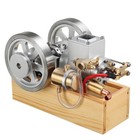
OKMO M93 6CC Horizontal Water-Cooled Gasoline Speed-Adjustable Hit & Miss Engine
Product Features:
This is a horizontal miniature gasoline engine model adopting a retro structural design.
It is equipped with a water-cooling system and a carburetor, and features adjustable speed.
Crafted elaborately from high-quality brass, aluminum alloy and stainless steel,
it boasts an exquisite and unique appearance as well as a stable and reliable structural design.
Fitted with a wooden base, it allows for easy placement and operation.
You will surely be captivated by such a retro and delicate gasoline engine model.
Product Specifications:
Model: M93
Material: Brass + Stainless Steel + Aluminum Alloy + Wood
Color: Silver
Displacement: 6 CC
Bore: 22 mm (0.87in)
Stroke: 20 mm (0.79in)
Cooling Method: Water Cooling
Starting Method: Hand Start
Ignition Method: CDI Ignition
Spark Plug Type: 1/4-32 Inch Thread Spark Plug
Power Supply: 4.5V (3 AA Batteries, Not Included)
Lubrication Method: Mixed/Splash Lubrication (Gasoline/Oil = 25:1)
Fuel Grade: 95# Gasoline
Oil type: 2T oil
Product Dimensions: 180×125×125mm (7.09×4.92×4.92in)
Product Weight: 1600 g
Package Contents: 1×Engine + 1×Cable Puller + 1×Spare Fuel Hose + 1×Instruction Manual
Packaging: Box
Engine Starting Procedures
1.Check the engine wiring on the wooden base, connect the fuel tank and fuel hose, and install 3 AA batteries (supply voltage: 4.5V).
2.Fill the fuel tank with the fuel mixture of gasoline and engine oil mixed at a ratio of 25:1.
3.Open the fuel hose filler, fully open the throttle lever, place your finger over the carburetor opening, and rotate the
flywheel counterclockwise 3–5 times. This will allow the fuel mixture to fully enter the cylinder and ensure there is no air in the fuel lines.
4.Turn on the power switch, wrap the starting rope around the small flywheel, rotate the flywheel counterclockwise,
and start the engine. After the engine starts, adjust the position of the throttle lever.
It is recommended to keep the engine running at low rpm for the first few operations to ensure a proper break-in period
and allow the mating surfaces of all moving parts to warm up sufficiently. Therefore,
avoid direct contact with the cylinder and exhaust components with your hands while the engine is running.
Diagnostic Troubleshooting Procedures
1.Starter and engine fail to rotate: First, check the battery level and wiring connections.
If the battery is in normal condition, inspect the starter circuit and ignition switch.
2.Adjust the throttle to the half-open position and attempt to start the engine. If the engine starts successfully,
the fault lies with the idle speed control valve, its wiring, or an intake pipe leak.
If the engine still fails to start with the throttle in the half-open position, proceed to the next step.
3.Visual inspection: Check for leaks in the intake pipe, verify the integrity of all pipes and their connections,
and inspect the crankcase ventilation system for air leakage.
4.Inspect high-voltage spark: If the high-voltage spark is abnormal, check the high-voltage wires,
ignition sensor, distributor, and electronic ignition system.